
Children’s Interests and Schemas in Early Learning
At Colleges Nursery School, we know children learn best when activities build on what genuinely interests them. By noticing their curiosities – such as building, role‑play or exploring outdoors – we create learning that feels meaningful and enjoyable.
We also observe children’s schemas: the repeated patterns of behaviour, like transporting objects, filling and emptying, or lining things up. These patterns show how children are thinking and exploring.
By combining children’s interests with an understanding of their schemas, we plan purposeful experiences that support confidence, concentration and problem‑solving, helping every child build strong early foundations for future learning.
Please follow this link for more information on Schemas.
Playing Outdoors
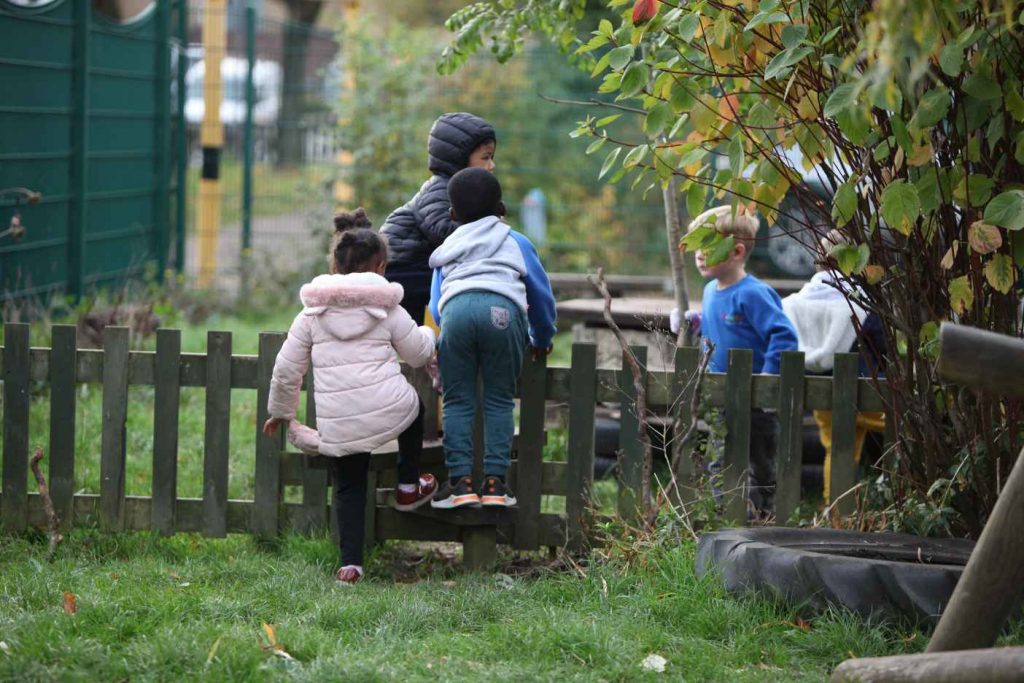
At our nursery we have an extensive outdoor garden, play area. We believe that children have a right to choose to play outside as well as inside throughout every season.
They are free to choose to play outside throughout the session. Our garden offers children access to climbing equipment, rope swing and ladders, a big sand pit and a large area for physical activities such as running and riding a range of tricycles and bicycles. We have a raised hill area and loose parts materials for exploration.
In our grassed wild area for natural play, children can choose messy play in the mud kitchen or to hunt for minibeasts. The fire circle allows use to have campfires and cook our own toast, hot chocolate or pancakes for outdoor snack.
In addition, a short walk from Nursery we have access to a private woodland area for activities that are inspired by the Forest School approach.
The importance of talk
Colleges staff create calm, language‑rich spaces that give every child, whatever their home language, the chance to share their thoughts.
Developing strong oracy skills are vital; speaking, listening and understanding is central to children’s early learning. Confident communication helps children express their ideas, build social relationships, and develop early reading and writing skills. We support oracy through rich daily interactions, storytelling, singing, and imaginative play.
Staff introduce new vocabulary, model clear language, and ask open‑ended questions that encourage children to think and talk. Through conversations, role‑play, and talking about experiences, children gain confidence, clarity and understanding, building vital foundations for future learning.
Partnership with Parents/Carers
We celebrate that parents and carers are their child’s first and foremost educators. Prior to starting we encourage parents/carers to participate in transition activities such as attending play visits and welcoming Key workers in for home visits; which help to start building trusting relationships.
When children first start we encourage parents into our nursery garden and inside our indoor spaces to help support with settling in to Nursery life. We keep parents involved with their child’s progress through an online interactive Learning Journal where both staff and parents can upload observations and photos.
We also have regular parent meetings and welcome parent/carers into the Nursery as visitors, as volunteers to help out at special events.
Parents and carers are always welcome to come and join in the fun!